22 Apr Top Office Cleaning Tasks by Frequency
A clean office is not just about appearance. Cleaning frequency affects employee comfort, supply reliability, odor control, floor life, and how clients judge your business within seconds of walking in. The real problem is not knowing what should happen daily, weekly, or monthly, which leads either to visible buildup or to paying for tasks too often. A frequency-based plan fixes that by matching each task to traffic, touch level, and risk.
What office cleaning tasks should happen daily?
Daily office cleaning must cover the items employees touch and guests notice first. In a Newark office or a Livingston professional suite, that means trash, restrooms, visible floors, and shared-touch disinfection on every service day.
Daily work is about risk and visibility, not perfection in every corner. If a task creates odor, germs, or a bad first impression within 24 hours, it belongs in the daily or every-visit bucket. That is why lobby glass, restroom sinks, and breakroom counters often matter more than blinds or vents.
A practical daily scope usually includes:
- Trash and recycling: Empty bins, replace liners, remove food waste
- Restrooms: Sanitize toilets, sinks, faucets, mirrors, and restock paper goods
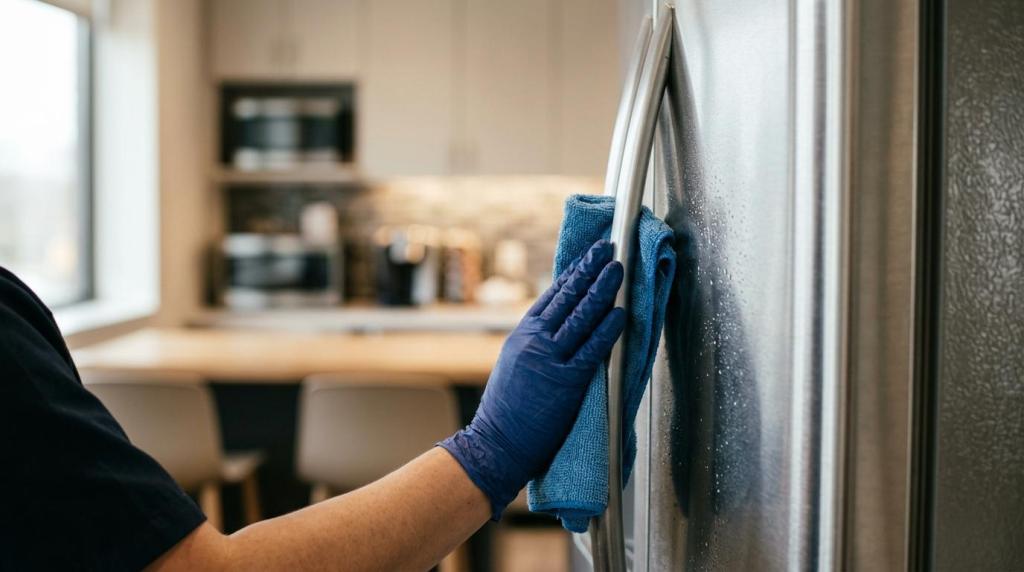
- High-touch points: Door pulls, light switches, refrigerator handles, shared phones
- Visible floors: Vacuum entry mats and traffic lanes, spot mop hard floors
- Breakroom reset: Wipe counters, tables, sink basins, and appliance exteriors
Pro tip: disinfection is not the same as a quick wipe. Many EPA-registered disinfectants need a label contact time, often 1 to 10 minutes, to work as intended. If that dwell time is skipped, the office may look clean without truly being disinfected.
Which office cleaning tasks belong on a weekly schedule?
Weekly office cleaning handles the slower buildup that employees still notice by Friday. In Bloomfield and Hackensack offices, this often means thorough dusting, full mopping, appliance cleaning, and glass touch-up beyond the front entrance.
Weekly tasks sit between maintenance and deep cleaning. They matter because daily-only service tends to leave edges, corners, and low-touch surfaces behind. Over a few weeks, that buildup becomes obvious and harder to remove.
Typical weekly tasks include more complete vacuuming under desks, damp mopping of all hard floors, dusting shelves and ledges, cleaning conference room glass, wiping chairs, cleaning the inside of microwaves, and polishing stainless steel in kitchens. In smaller offices under roughly 3,000 square feet with limited visitors, weekly service is often the most cost-efficient starting point. If traffic is heavier, weekly becomes the support layer under a daily core scope.
A common misconception is that desks always need full weekly detailing by the cleaning crew. In many offices, cleaners should only clean exposed surfaces unless the client wants a clear-desk policy. That protects documents and reduces liability around personal items.
What office cleaning companies or service models are useful benchmarks for cleaning frequency in New Jersey?
New Jersey offices can benchmark frequency against a few practical models. Maids 4 Jersey, Cleaning USA, and Team Alpha Cleaning each reflect a different way to organize recurring tasks, periodic tasks, and service communication.
If you are comparing providers, look less at slogans and more at how clearly they separate every-visit tasks from rotating tasks. A provider with a clean frequency map usually produces more consistent results.
- Maids 4 Jersey: A strong fit for small offices and professional suites in Nutley, Bloomfield, Belleville, Verona, West Orange, Livingston, Cedar Grove, and Glen Ridge. The useful benchmark here is reliable scheduling, consistent teams, supplies included, and a recurring service model that suits offices wanting less management overhead.
- Cleaning USA: A helpful benchmark for explicit daily-versus-weekly checklist thinking. This model is useful if you want clearly labeled essentials and periodic tasks.
- Team Alpha Cleaning: A good benchmark for traffic-based scheduling. This approach is useful when restrooms and kitchens need more attention than private offices.
- In-house porter plus specialist vendor: Often the right model for larger buildings where daytime restroom resets and lobby upkeep are needed, but floor care and deep work are outsourced monthly or quarterly.
If your office is in Essex County or Bergen County and you want a practical recurring scope rather than a one-size-fits-all contract, request a quote and compare the proposed task frequencies, not just the visit price.
How do you build an office cleaning schedule by square footage and headcount?
A good office cleaning schedule starts with space use, not guesswork. A 2,000-square-foot office in Glen Ridge behaves very differently from a 6,000-square-foot suite in Hackensack with steady client traffic.
Step 1 is to divide the office into zones: reception, workstations, conference rooms, restrooms, kitchen, and storage. Each zone soils differently. Reception gets judged first. Kitchens collect grease and crumbs. Restrooms create hygiene risk fastest.
Step 2 is to match frequency to headcount and traffic. As a practical rule, offices under 2,500 square feet with fewer than 15 staff often do well with weekly or twice-weekly service, unless they are public-facing. Offices from about 2,500 to 7,500 square feet with 15 to 40 staff usually need two to five visits per week. If clients are in and out all day, increase restroom, entry, and lobby frequency first.
Step 3 is to assign fixed tasks and rotating tasks. Fixed tasks happen every visit: trash, restrooms, high-touch points, visible floors. Rotating tasks fill the remaining labor time: interior glass this visit, vents next visit, baseboards later in the month. If labor is limited, protect the fixed tasks first and rotate the cosmetic items second.
How should restroom cleaning frequency compare with breakroom cleaning?
Restrooms usually need more frequent cleaning than breakrooms. In West Orange and Lodi offices, restroom failure is noticed faster and judged more harshly than a lightly used kitchen counter.
The right balance depends on occupancy, public access, and food use. A small private office may tolerate a lighter kitchen schedule, but restrooms still need routine disinfection and restocking.
| Area | Minimum practical frequency | What increases frequency | Why it matters |
|---|---|---|---|
| Restrooms | Every visit, often daily in occupied offices | Public access, more than 10 to 15 users, limited stalls | Hygiene risk, odor, supply outages, client perception |
| Breakrooms | Every visit for touch points, deeper weekly detail | Daily lunches, shared fridge, coffee station, food prep | Crumbs, grease, odors, pest prevention |
| Reception coffee bar | Daily if used by guests | Client traffic, self-serve drinks | First impression, spills, fingerprints |
Common misconception: breakrooms are “lower priority” because they are not as public as restrooms. In reality, food residue attracts pests and creates odor quickly. If staff eat on site every day, kitchen wipe-downs may need the same visit frequency as restrooms, even if the deep appliance cleaning stays weekly.
How do you decide between daily, weekly, and monthly office cleaning?
The best way to assign frequency is to classify each task by consequence. If delaying a task creates hygiene risk, odor, or visible mess within a day, it belongs in the daily group.
Step 1 is to ask what happens if the task is skipped once. If the answer is overflowing trash, empty soap, sticky counters, or dirty entry floors, that task is daily. If nothing serious happens for several days, move it down a band.
Step 2 is to score visibility and touch level. A conference room door handle has high touch and high visibility, so it belongs in the high-frequency bucket. A supply closet vent has low touch and low visibility, so monthly is usually enough.
Step 3 is to test the schedule for two to four weeks. If fingerprints return by noon, increase glass and touch-point frequency. If baseboards still look fine after a month, keep them monthly. If then logic works well here: if a zone is client-facing, raise frequency; if a zone is low traffic and closed-door, rotate it.
Is nightly janitorial service better than daytime office cleaning?
Night cleaning is usually better for uninterrupted work, while daytime cleaning is better for live resets. In Belleville and Saddle Brook, small offices often prefer evening service, but busier suites sometimes need a daytime porter.
The trade-off is operational, not cosmetic. Night crews can vacuum and sanitize with less disruption. Daytime coverage catches spills, restocks restrooms, and keeps reception presentable during business hours.
| Factor | Night service | Daytime service |
|---|---|---|
| Employee disruption | Low | Medium |
| Morning appearance | Strong | Depends on timing |
| Midday restroom resets | Weak | Strong |
| Spill response | Weak | Strong |
| Security and access | Needs after-hours entry | Needs on-site coordination |
| Cost efficiency for small offices | Often better | Often higher |
Pro tip: many offices do best with a hybrid plan. Use recurring evening cleaning for the main scope, then add a short daytime visit once or twice a week if the kitchen, lobby, or restrooms take a beating.
How do you audit whether office cleaning tasks are actually being completed?
A real office cleaning audit uses observable checkpoints, not scent. Lysol and Mr. Clean can leave a strong smell, but smell alone does not prove restrooms, touch points, or edges were cleaned.
Step 1 is to build a written scope by frequency. Without that, nobody can tell whether a missed task is a defect or just a task scheduled for next week. Step 2 is to inspect the same five checkpoints every time: entry glass, restroom supplies, sink fixtures, floor edges, and breakroom counters. Step 3 is to log misses by pattern, not emotion. One miss can happen. Repeated misses in the same zone mean the schedule or staffing needs to change.
A quick audit can use signals like these:
- Green flag: Fresh liners, stocked dispensers, dry mop lines, no smudges on glass at opening
- Yellow flag: Dust collecting on ledges before the next scheduled visit, sticky microwave handle, dull corners
- Red flag: Empty restroom supplies, overflowing trash, fingerprints on reception glass, visible debris under desks
Common misconception: if the office smells “clean,” the job was done well. Good quality control is visual and repeatable.
Which office cleaning tasks are essential and which are supplementary?
Essential office cleaning tasks are the ones that protect hygiene and day-to-day appearance. Supplementary tasks improve long-term condition, detail, and finish, but they do not usually need every-visit labor.
This distinction matters because many offices overbuy cosmetic work and underfund the basics. If trash, restrooms, floors, and touch points are weak, adding more glass polishing will not solve the problem.
A useful split looks like this:
- Essential: trash removal, restroom sanitation, restocking supplies, high-touch disinfection, visible floor care, breakroom counters and sinks
- Supplementary: full interior glass, vent dusting, blind cleaning, baseboards, upholstery touch-up, deep carpet extraction, machine floor scrubbing, polishing
The trade-off is simple. Essential tasks preserve function and health. Supplementary tasks preserve finish, appearance depth, and asset life. Both matter, but not at the same frequency.
When should you add deep cleaning, carpet extraction, or floor care?
Deep cleaning should be added when maintenance cleaning stops resetting the space. In Cedar Grove or Verona offices, that often happens at the first service, after winter salt season, after renovations, or before an important client event.
Maintenance cleaning is for control. Deep cleaning is for correction. If grease remains in the breakroom, grout has film, corners stay dusty after routine visits, or carpets hold odor, you are past the maintenance stage.
This is also where service type matters. Office cleaning is for teams that need regular upkeep with reliable scheduling. Deep cleaning is for first-time clients, seasonal resets, or offices that have drifted. Move-in or move-out cleaning fits lease turnover and ownership transitions. Post-construction cleaning fits remodels, build-outs, or new tenant improvements where fine dust reaches vents, sills, and cable trays.
In New Jersey, winter brings salt and grit, while spring brings pollen and moisture. Both shorten the useful life of routine-only programs. If your office floors look gray near entries or carpets feel loaded even after vacuuming, schedule a deeper reset before returning to a lighter recurring plan.
How often should small offices in Essex County and Bergen County schedule cleaning?
Most small offices in Essex County and Bergen County need service one to three times per week. A quiet Cedar Grove office may do fine weekly, while a busy Livingston or Bloomfield suite with daily visitors may need two or three visits.
A practical local pattern looks like this: once weekly for low-traffic back offices, twice weekly for standard professional offices, and three-plus visits weekly when there is steady foot traffic, shared kitchens, or customer-facing reception. Offices in Nutley, Belleville, Glen Ridge, West Orange, Hackensack, Garfield, Lodi, and Saddle Brook often need a bump in entry-floor care during wet or snowy months because salt and street grit show up fast.
If you manage both a workspace and a home, related local pages can help keep standards consistent across properties, including house cleaning in Nutley, NJ, cleaning services in Bloomfield, NJ, and deep cleaning in Verona, NJ. For recurring office cleaning, deep cleaning, move-in or move-out cleaning, apartment cleaning, or small office service in Essex County and Bergen County, schedule today or request a quote and build a frequency plan that matches how your office actually works.
Sorry, the comment form is closed at this time.